

By Nerissa Kusi
I was at a science conference last year in April. Whilst there, someone introduced me to a fellow scientist saying “Nerissa is also Ghanaian”. However, when I spoke about being from London the other Ghanaian scientist, who had moved from Ghana for her PhD told me “So you’re British, not Ghanaian”. And that made me pause. Yes, I am very much British; I was born in London, schooled here and will probably live here for the majority of my life. Despite this, I have also always seen myself as being firmly Ghanaian.
But it’s hard sometimes, being Ghanaian but part of the diaspora and knowing how you fit in within the community. I confess that I’ve felt like that myself as well. I used to have imposter syndrome with regards to my ‘Ghanaianness’. I eat the foods but can’t cook them, I understand the language but can’t speak it, I know the culture but needed to be taught about different funeral and wedding rites. I have a Ghanaian name, but outside of my house everyone calls me by my very European first name. And so, I’ve decided to reach out and ask some of these questions I have to others to get their views on what it means to grow up as part of the Ghanaian diaspora in the UK.
Thank you for speaking to me. Please tell us your name and profession.
Abaka: Hi, my name is Abaka aka Abs. I’m 23 and work as a research analyst for a consulting firm.
Rose: Hello, I’m Rose, I’m 25 and a civil servant.
Michael: Hello, my name is Michael and I’m a 32-year-old creative from East London.
How would you describe your upbringing as part of the Ghanaian diaspora in the UK?
Abaka: For me, I didn’t really deep it until I moved to London when I was 12? 13? Before that I was living in Crawley, which is a very white area and then in Birmingham, which has a large Asian community. I don’t think you can really see yourself as part of a diaspora until you’re living amongst other members of that diaspora. Even when I was in London, I grew up with a lot of Nigerians at school and only really saw other Ghanaians outside of my family at church on a Sunday. It wasn’t until I went to university that I started to see myself as part of the Ghanaian diaspora and part of a larger ecosystem instead of a Ghanaian living in London with other Londoners.
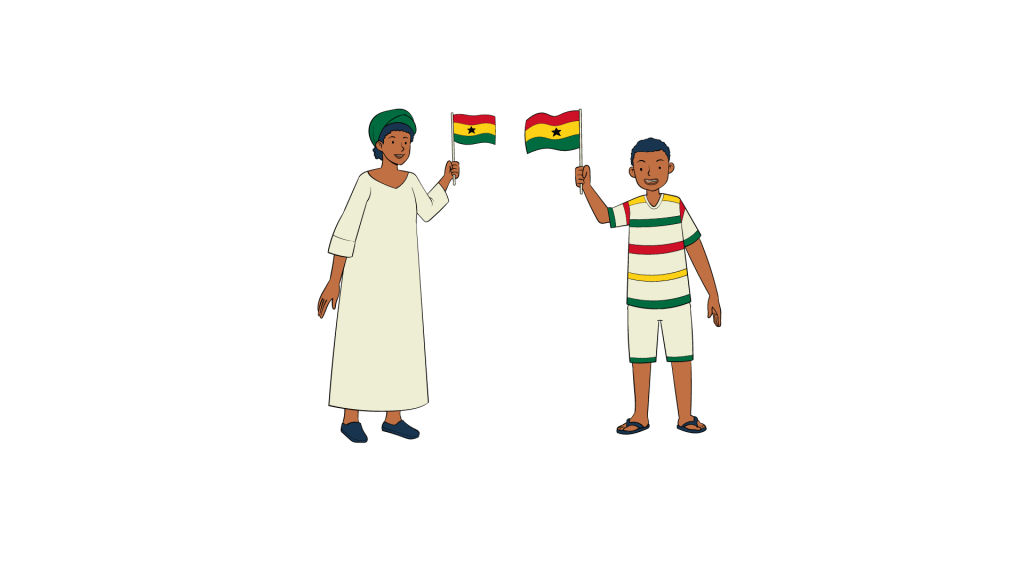
Rose: As children of immigrants, I think our parents work so hard to integrate into UK society and that was the same for my parents even though they went to English-speaking schools in Ghana and came here when they were relatively young. They still had to work hard in the UK to find their feet and get naturalized. So, for me and my upbringing, there was always an emphasis on being Ghanaian but also British. In secondary school, those around me were like me. We were all the children of immigrants who knew about the same levels about our home countries. So, I had Nigerian friends who couldn’t speak Yoruba or Igbo, St Lucian friends who couldn’t speak Creole. Despite having what could be considered as surface-level understanding of these countries, we still drew a lot of pride in where we were from. Ghana Independence Day would have me bringing a flag to school. Ghana Party in the Park was an annual event that I always went to. I listened to high-life and Ghanaian gospel music outside of hall parties and church on a Sunday.
Michael: As a British born Ghanaian, I’m hoping I can do this question justice. Without a doubt it was surrounded by a protective layer of culturalism. My mother & father being strong believer of the idea that no one loves you better than those we who are in this home. Obviously as we grow, we know the weight of this as well as understanding where such a thought process centers from but certainly it was the best of both worlds, which undoubtedly has created a balance and allowed me to have a healthy outlook on life.
Do you think you were exposed to the culture as a child? In what ways?
Abaka: Yeah, I guess, in language and food. My grandma would tell us Anansi stories and we would see our culture in the artwork at home and in the people invited to our house. Also, our names played a big part of that. My siblings and I all have Ghanaian first names.
Rose: Yes and no.I think naturally, the Ghanaian culture was part of my parents’ upbringing and so became part of mine. I was exposed to the music, the language, the foods, the mannerisms, and the traditions. But now that I reflect back as an adult, I can see that there was a cap on how much I was exposed to as a child.
Michael: As a child, wow, such a long time ago. The easiest and most common memory is the food. The culture was embedded in it. There was no such thing as having a meal outdoors. Or enjoying things outside the home, everything was indoors. It was deemed that everything you have is at home, not just as a last resort but as the best resort. Slowly you start learning the importance of things being natural, which we are funnily enough all going back to. And that was what the food represented. Natural, unprocessed, organic. Also, the element of discipline was taught through this. Not giving over to the urges of your desires or cravings. This was the culture. From young till now! It was engrained in the walls, and if the walls could talk…
Did you grow up speaking your native language? If not, what stopped you from learning to speak it?
Abaka: No, I didn’t grow up speaking Twi because my parents were selfish. Just kidding. I think they really wanted us to be well-spoken in the English language and so only really spoke Twi amongst themselves. It’s only when my grandma started living with us that she started teaching us Twi, so I understand it but can’t speak it.
Rose: It’s frustrating because I understand it fluently but cannot speak Twi. Part of it was that my parents wanted us to excel at school and that often requires high levels of English. And so that just became the norm. My parents always spoke in Twi, and I would reply in English. It doesn’t help that when I tried to speak Twi, especially when amongst my extended family both here and in Ghana, I would be laughed at for my British accent which discouraged me from try further. I do still want to learn one day.
Michael: The language is the most beautiful part, but yet the most trickiest. Laughed at if not spoken well enough, whilst simultaneously disappointing those who laugh at the fact that we can’t speak the language. This was the struggle. In exchange learning the code of the streets is what became the supplement. However, as time has gone on, and maturing as a man, the language became important, a real part of my identity. So, though I may speak it in chops and pieces gradually I’m learning the language, with the encouragement of close people & family!
Did you get the chance to go back to Ghana regularly?
Abaka: Unfortunately not, because of immigration issues. The only time we managed to get everything sorted and plan a trip was in 2020 and obviously Covid stopped that from happening. But I do plan to go soon and want to make it a regular thing.
Rose: I’ve been a few times, more so when I was younger. I’m not an only child, so it would have cost more money to take me and my sister back. There was a large gap between my most recent visit and the one before. I was last in Ghana at the end of 2018/start of 2019 and am making plans to go back again soon.
Michael: Unfortunately, the opportunity to go back wasn’t given to me. Simply put, the capital to do so wasn’t there. With that being said however, I completely understand why.
As an adult, do you feel like you know more about Ghana?
Abaka: I definitely know about Ghana due to my nature of curiosity and inquisitiveness. With the career I have now, I want to learn more about West Africa, Ghana in particular, in terms of international development and government which has made me more interested in what’s going on in Ghana.
Rose: I don’t know. I definitely don’t know less, but I can’t say that I know more than I did as a child.
Michael: Sadly, I don’t know enough even as an adult. Relatability, a lack of interest. I think there’s a small interest forming but we will see what the future holds.
How do you feel now about your Ghanaian identity?
Abaka: Yeah man, it’s lit. I love it. Genuinely I do love it. It’s something I cling on to dearly and I’m proud to say I’m Ghanaian. Overall, I think there’s been a shift in balance, not just in being Ghanaian but in being African in general. Back in school no-one wanted to admit to being Africa. Not it’s trendy and dark skin love and all that, but that’s a whole separate conversation.
Rose: Being Ghanaian goes beyond speaking the language and eating the foods. It’s also the mannerisms that you pick up from your parents, the banter you have with other Ghanaians that people who aren’t Ghanaian can’t share in.
Michael: I count it a privilege to be from Ghana, and I embrace it in my identity more than I ever have done. Especially as an artist, seeing the wealth it holds and the stories within the red sands brings a life to me that I just won’t find here in the UK. There’s something about Ghana that carries home, without being there. Maybe it’s the culture, or my parents, but there’s always a tugging. Ghanaian passport soon come.
If someone was to ask you now “Where are you from?”, what would be your answer?

Abaka: It depends on who’s asking. If it’s a work colleague I’d probably say London, just to throw them off because I know what they’re truly asking for. If it’s a fellow African, then I’d say Ghana. But either way, I wouldn’t shy away from saying Ghana.
Rose: I think this is dependent on where I am in that moment. When I was on my year abroad, I would say the UK. However, when in the UK, or somewhere were seeing black people is the norm as it’s more diverse (as opposed to Barcelona), I almost always respond Ghana. I’m sure if I was in the US and someone asked me this question I’d say Ghana, but that I live in London. Interestingly, when I was doing a work interview, I got asked if I felt more British or Ghanaian. And I literally paused. Although I knew that they wanted me to say British, I had a 2-minute conversation about why I saw myself as being more Ghanaian. And I think this constant battle is one that many of us face in being part of the diaspora. So now I would answer that I’m British but that my heritage is very much rooted in Ghana and in Ghanaian culture.
Michael: That question carries so much weight. There’s obviously the blatant fact that I was born in the UK, in Newham, London to be precise. That’s almost in the pores of my skin. But in the same breath, my skin also tells me that I’m a migrant of a colonised land and so yeah, there’s a part of me that still says “I’m from Britain, but my parents are from Ghana”. And I don’t talk about my parents as an afterthought but as a reminder that there is a place where my heritage lays beyond what we see here in the UK.
What are practical things you want to do in the future to hold on to your heritage and pass it down to any future children?
Abaka: I guess teaching them the language that I never got to learn. How I’m going to do that? Only God knows. Getting them back to Ghana as much as possible. Passing down stories in the same way my grandma did. As a historian, I think that oral history is one of the most beautiful tools to passing down culture. Also, I just need to experience it myself as much as possible before I have children as I can’t pass down what I don’t know.
Rose: Listening to Ghanaian news and the radio and engaging in the politics, will make me feel like I’m part of the country and not someone who only associates Ghana with holidays. I want to know what each political party stands for and as someone who works in the government, I definitely feel like this is not beyond me. In general, I don’t want to deny my Ghanaian mannerisms but instead embrace them. If I don’t marry a Ghanaian who is in touch with their culture, then some practical steps can include regular trips to Ghana, and keeping my children in contact with the family that we have in Ghana, though it’s decreasing in number. I also think that just reminding my children from early that although they are British, they are also very much Ghanaian would be a positive thing.
Michael: I think the most important thing would be to remind them of their heritage in the same way I was reminded. I don’t want to rob them of the language and want to instead encourage them to speak as much as possible, even if it’s not spoken well. The foods should be a representative of their ethnicity and even the stable pieces that you carry in your home should let one know that you’re from Ghana. As someone who married cross-culturally (my wife is Nigerian), there’s and even greater emphasis on myself to make this an intentional act. I want to put my children in the midst of my parents and my forefathers such as aunts and uncles who are rich in the culture and can help me to pass this down.
I’m glad I got to speak to other people who had been feeling similarly to me and want to open these questions to everyone. I have friends who do speak Twi and speak it well and who go back to Ghana often, and I wonder if this helps them to feel more rooted in their Ghanaian heritage. I definitely will be asking them the same questions and probing their thoughts. I encourage us all to have an open dialogue about this and remember that your Ghanaian identity is personal to you and shouldn’t be dictated by anyone else. I feel Ghanaian, and so I am.
 GYP UK